
Open 24 hours, 7 days a week
Water heater replacement, done to Florida code
The old tank comes out, the new one is set, strapped and connected to code, and a permit is pulled where the work requires one, so the installation is not something to revisit later.
How do I know if my water heater needs to be replaced instead of repaired?
A tank that is rusting from the outside, leaking at the tank itself rather than a fitting, or making a rumbling sound from years of sediment buildup is usually past the point where repair makes sense. Most tank water heaters are built for roughly 8 to 12 years of service, and Florida’s heat and mineral-heavy water tend to shorten that rather than extend it. A tank already at or past that range with a new symptom is a strong candidate for replacement rather than another repair.
A leak at a fitting, a bad heating element, or a thermostat issue can often be repaired instead, without touching the tank itself at all. The difference is usually visible: a leak from a joint or a valve is a repair, a leak weeping from the tank shell itself is not. A plumber can tell you which one you are looking at before recommending either, rather than defaulting to the more expensive option.
Signs it is time
When replacement makes more sense than repair
Rust-colored water from the hot tap only
The tank itself is corroding from the inside, not the supply line.
A rumbling or popping sound when heating
Sediment buildup at the bottom of the tank, common after years of mineral-heavy water.
Water pooling at the base of the tank
A leak from the tank shell itself rather than a fitting, which is not repairable.
The tank is past 10 to 12 years old
Most tanks are not built to run reliably much past this range.
Inconsistent hot water even after repairs
Repeated fixes that do not hold usually mean the tank itself is failing.
What the installation includes
Strapped, drained and permitted correctly
A code-compliant installation in Florida includes seismic-style strapping to hold the tank in place, a drain pan with a line routed to a safe discharge point, and a permit pulled through the local building department for the work. Depending on the home’s plumbing and the local code interpretation, an expansion tank may also be called for on a closed system.
None of that is optional add-on work. It is what makes the installation something that passes inspection and holds up, rather than something that gets flagged the next time anyone looks at it, or the next time the home changes hands and a buyer’s inspector checks the utility space.
Tank or tankless
Choosing between a replacement tank and going tankless
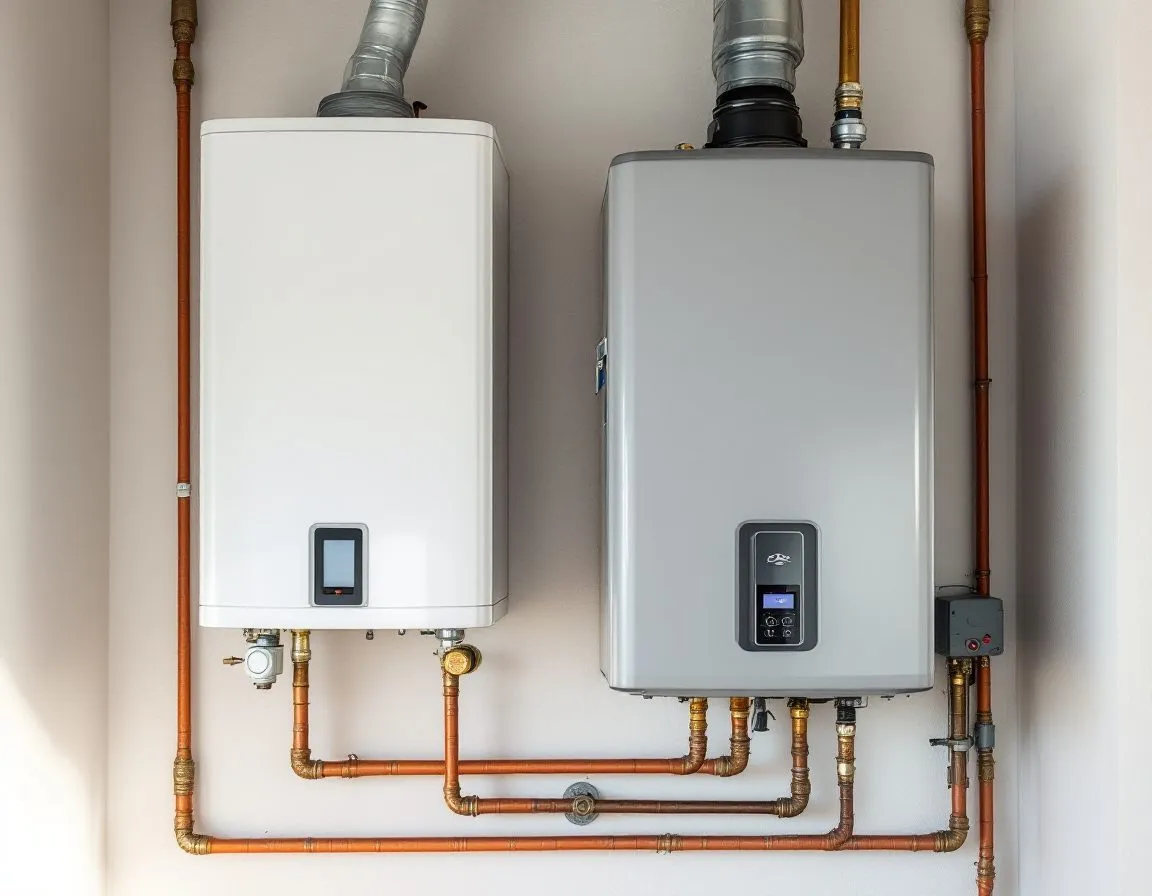
A like-for-like tank replacement is usually the faster and more straightforward option, and it fits the existing gas or electric connection without further work in most cases. A tankless unit takes up less space and can supply hot water without the standby tank, but it often calls for changes to the gas line sizing or the electrical circuit, which adds to the scope of the job.
Either can be the right call depending on the house, the fuel source available, and how the space is used. A plumber can walk through both before you decide, without steering you toward the more expensive option by default.
Questions
Water heater replacement, answered
How long does a water heater replacement take?
A straightforward like-for-like tank swap is usually a same-day job. A switch to tankless, or a setup that needs gas or electrical changes, can take longer depending on what is involved.
Do I really need a permit for this?
In most of Broward County, yes, a permit is required for water heater replacement, and it is what gets the installation inspected and signed off.
Why does my tank only last 8 to 10 years here?
Florida’s mineral-heavy water and warmer ambient temperatures both accelerate the sediment buildup and corrosion that eventually wear out a tank.
Can you match the size of my current tank?
Yes, and it is also worth checking whether the current size actually fits how the household uses hot water before replacing it with the same one.
What is an expansion tank and do I need one?
It absorbs the pressure increase that happens when water heats in a closed system, and some local code interpretations call for one. A plumber can tell you whether your setup needs it.
Live dispatch
Tank leaking, or just past its years?
Call and describe what you are seeing. A plumber can tell you whether it is a repair or a replacement before any work starts.
No obligation to book after the call.